
Oct 15, 2026 · 11 min read
Best AI Recruiting Tools in 2026: What Each Category Does and How to Choose

Saad Sufyan
Share:
Founder & CEO @ Codesy Consulting | Building ConnectDevs, an AI-Powered Hiring Platform | Helping Companies Scale with Elite Software Engineers, AI Solutions & Digital Transformation | Worked with Startups, Enterprises & Fortune 500 Brands
Best AI Recruiting Tools in 2026: What Each Category Does and How to Choose
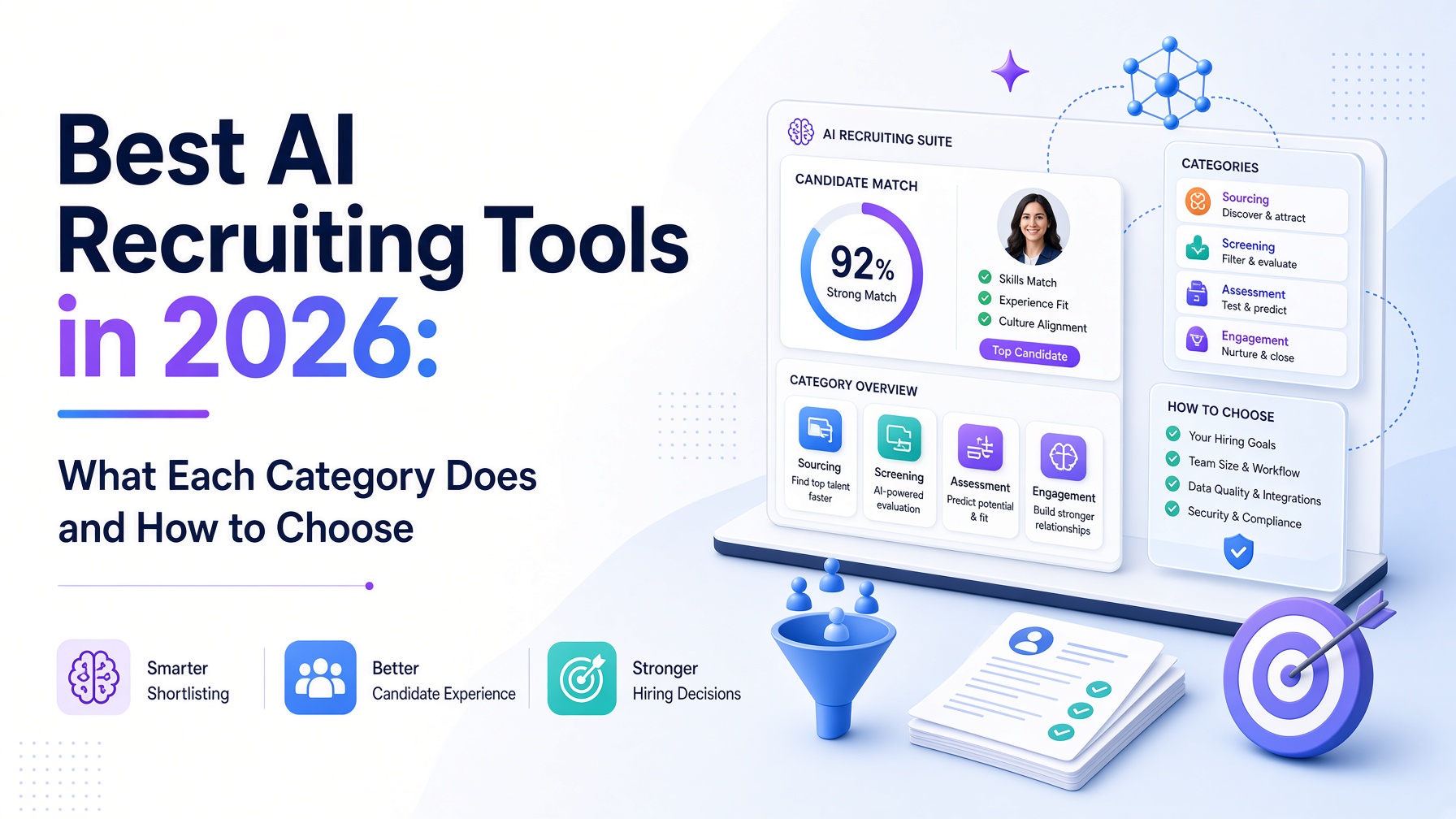
The best AI recruiting tools are not one product. They are six categories of software, and most teams only need two or three of them. This guide breaks down sourcing, outreach, screening, interviewing, ATS-with-AI and scheduling tools, names real vendors in each, and gives you criteria to choose without getting sold a "full stack" you will not use.
Pricing below comes from vendor pages checked in October 2026. Vendors change plans often, so confirm before you budget.
TL;DR
- Buy by bottleneck. If you cannot find candidates, start with sourcing. If you drown in applicants, start with screening or an ATS with AI review.
- Public pricing is rare. Only some vendors publish it (Juicebox, SeekOut Core, Workable, Ashby, Metaview); Greenhouse, Paradox, HireVue and GoodTime sell by quote.
- Treat vendor claims as vendor-reported until you test them on your own roles.
- AI in hiring is regulated. The EU AI Act classes candidate filtering and evaluation as high-risk, so keep a human on every decision.
Table of Contents
- What counts as an AI recruiting tool
- Where adoption stands in 2026
- AI sourcing tools
- AI outreach tools
- AI screening tools
- AI interviewing tools
- ATS platforms with AI
- Scheduling and automation tools
- Comparison table
- How to choose: seven criteria
- Sample stacks by team type
- FAQ
- Conclusion
What counts as an AI recruiting tool
An AI recruiting tool is software that uses machine learning or language models to do part of the hiring workflow: finding candidates, contacting them, evaluating them, interviewing them or coordinating the process.
That definition is broad on purpose. A keyword filter with an "AI" badge does not count. A tool that reads a job description, ranks people and explains why does.
Many vendors now blur the lines. Gem, SeekOut and Metaview each cover several stages. Still, each one is strongest in one place. That is why organizing by category beats a single ranked list.
Where adoption stands in 2026
Adoption is real but uneven. According to SHRM research covering 1,908 HR professionals, 39% of organizations use AI in HR functions. Recruiting and talent acquisition leads at 27%, the highest of any HR function.
Size matters. The same research shows about 60% of organizations with 5,000+ employees use AI in HR, and well under that among smaller ones. Just under half have a formal AI policy.
Candidates are less enthusiastic. A Pew Research Center survey of 11,004 U.S. adults (December 2022) found Americans oppose AI making final hiring decisions by 71% to 7%. The data is older, but it explains why "AI recommends, human decides" is the safe design.
AI sourcing tools
AI sourcing tools search large profile databases from a plain-language brief and return ranked candidates, so recruiters spend less time writing Boolean strings.
Use them when your pipeline, not your inbox, is the problem. For a deeper look, read our guide on how to find passive candidates beyond LinkedIn.
Vendors to know
- SeekOut. Describes itself as an agentic AI recruiting platform and cites 1B+ profiles. Its self-serve Core plan is listed at $149/month billed annually or $179/month billed monthly, with unlimited searches and 500 monthly contact credits. Higher tiers are quote-only. See our SeekOut alternatives comparison.
- Juicebox. Lists "800 million profiles" and plans from Free to Growth ($179/month on monthly billing, $199 on the yearly rate shown), plus a Business tier by quote. Agents are an add-on at $199/month each.
- ConnectDevs Scout. AI Sourcing runs natural-language search over a published 800M+ public-profile graph, returning ranked matches with reasoning. It is a sourcing layer, not an ATS.
Limit to remember: every database has gaps. Coverage of niche or non-US talent varies, so run the same brief in two tools before you commit.
AI outreach tools
AI outreach tools write, personalize and sequence candidate messages, then track replies, so one recruiter can run many conversations at once.
Reply rates depend more on relevance than on volume. Personalization from real profile data beats a clever template.
- Gem. Layers sourcing, outreach, scheduling and analytics on top of your ATS, or runs as an all-in-one with its own ATS. Pricing is by company headcount. Its published startup example is $130/month (billed yearly) for 1-10 FTEs.
- Juicebox. Includes email outreach on paid plans, with AI email templates even on the free tier.
- ConnectDevs Pilot. Pilot sends multi-touch outreach from your own Gmail, which keeps messages tied to your sender reputation.
Limit to remember: automated sequences can hurt your brand fast. Cap daily volume and review the first batch by hand.
AI screening tools
AI screening tools score inbound applicants against job criteria and surface the strongest ones, replacing the first manual resume pass.
This category matters most for high-volume roles. Our walkthrough on how to screen high-volume job applicants covers the process side.
- Workable AI Agent. Usage-based credits on top of a plan. Every plan includes 3,000 free credits; evaluating a candidate costs 1 credit and sourcing a passive candidate costs 2. Extra packs start at $600 for 5,000 credits.
- Paradox (Olivia). A conversational assistant that screens by chat or text and also handles scheduling and onboarding. No public pricing.
- Gem and Metaview. Both offer application-review agents inside broader platforms.
Limit to remember: screening is where bias and legal risk concentrate. Ask each vendor for bias-audit documentation and make sure rejections are reviewable.
AI interviewing tools
AI interviewing tools do one of two jobs: they run a first-round screening interview for you, or they record and summarize the interviews your team runs.
Know which job you are buying. Our full roundup of the best AI interview software goes deeper on both.
- HireVue. Offers an AI Interviewer for screening interviews, video interviewing, and assessments, with 45+ ATS integrations. Pricing by demo request.
- HeyMilo. Automates screening through AI phone and video interviews, with cheat detection and 20+ languages. It claims "87% faster screening" (vendor-reported). No public pricing.
- ConnectDevs SAM. The AI Interviewer runs voice-based structured screening interviews and produces transcripts and ranked reports.
- Metaview and Ashby. Cover the notetaking side. Metaview lists Pro at $100/month per user; Ashby's AI Notetaker is a paid add-on.
Limit to remember: candidates may dislike talking to a bot. Tell them up front, offer an alternative path and keep humans in the final round.
ATS platforms with AI
An applicant tracking system (ATS) is your system of record for candidates and jobs; "ATS with AI" means the record-keeper also scores, searches and summarizes.
Most AI tools plug into an ATS rather than replace it. Pick the ATS first, then add specialists around it.
- Ashby. Foundations plan is listed at $400/month for companies up to 100 employees. AI features include natural-language candidate search, AI-assisted application review and a candidate assistant. Foundations includes 1,500 AI credits monthly.
- Workable. Standard is $299/month, Premier $599/month and Enterprise $719/month as listed, with a 15-day trial.
- Greenhouse. Core, Plus and Pro tiers, priced by quote. Core includes an AI Notetaker and scheduling; Plus adds sourcing automation, texting and fraud detection.
Limit to remember: built-in AI is convenient but rarely best in class. A startup can start here and add a specialist later. See our guide to AI recruiting software for startups.
Scheduling and automation tools
Scheduling and automation tools coordinate interviewers, candidates and calendars automatically, cutting the back-and-forth that stretches time to hire.
- GoodTime. Automates complex interview scheduling with two-way ATS sync. Pricing is quote-based and tied to annual candidate volume. It reports an "88% reduction in time spent scheduling" for one customer (vendor-reported).
- Paradox. Lets candidates pick slots through chat, and covers events and onboarding.
- Greenhouse and Gem. Include scheduling inside their platforms.
Scheduling is the quietest win. It rarely shows in demos, but it removes days from the process. To measure that effect, see how to reduce time to hire for technical roles.
Comparison table
| Category | Vendors | Public pricing (as listed) | Best for |
|---|---|---|---|
| Sourcing | SeekOut, Juicebox, ConnectDevs Scout | SeekOut Core from $149/mo (annual); Juicebox Free to $179/mo; Scout on the pricing page | Thin pipelines, passive candidates |
| Outreach | Gem, Juicebox, ConnectDevs Pilot | Gem by headcount; Juicebox included on paid plans | Low reply rates, small recruiting teams |
| Screening | Workable, Paradox, Metaview | Workable credits from 1 per evaluation; Paradox by quote | High applicant volume |
| Interviewing | HireVue, HeyMilo, ConnectDevs SAM, Metaview | HireVue and HeyMilo by quote; Metaview Pro $100/user/mo | First-round screens, interview notes |
| ATS with AI | Ashby, Workable, Greenhouse | Ashby $400/mo; Workable $299-$719/mo; Greenhouse by quote | System of record |
| Scheduling | GoodTime, Paradox | Both by quote | Coordination-heavy hiring |
Where does ConnectDevs fit? It covers sourcing (Scout), screening interviews (SAM), enrichment and outreach (Pilot). Published plans are Free, Starter $99, Growth $189 and Scale $459 per month, credit based. It does not replace an ATS, and it does not do interview scheduling, so pair it with the system you already use. Plans are listed on the ConnectDevs pricing page.
How to choose: seven criteria
The right AI recruiting tool is the one that removes your biggest bottleneck, fits your ATS and passes a test on your own roles. Use these seven criteria.
- Bottleneck fit. Name the stage where candidates stall. Buy for that stage only.
- ATS integration. Check for a two-way sync, not just a CSV export. Juicebox lists 41 ATS integrations and HireVue lists 45+, so ask for specifics.
- Transparency. Ranked results should come with reasons. If a tool cannot explain a score, you cannot defend it.
- Pricing model. Seat, credit and quote-based pricing behave differently at scale. Model your real monthly volume.
- Compliance. The EU AI Act Annex III lists AI used to analyse and filter job applications and evaluate candidates as high-risk. Ask vendors for audit and data-handling documentation.
- Data coverage. Test your hardest role, not an easy one.
- Proof on your data. Run a two-week pilot and compare against your current process. Vendor-reported numbers are a starting point only.
Cost matters too. Compare any subscription against your current cost per hire for engineering roles before you sign.
Sample stacks by team type
Startup hiring manager
Start with a lean ATS (Ashby or Workable), add one sourcing tool and use free tiers first. Skip dedicated scheduling until volume demands it.
Agency recruiter
Prioritize sourcing and outreach. Agencies live on speed to shortlist, so pick tools with fast search and email sequencing. Our piece on recruiter productivity and placements per recruiter shows what to measure.
In-house team at scale
Lead with the ATS, then add screening and scheduling. Governance matters more here, so involve legal early. To see what is automated and what is not, read about what AI recruiting agents actually automate.
If LinkedIn costs are the driver, compare options in LinkedIn Recruiter alternatives.
FAQ
What are the best AI recruiting tools?
There is no single best. SeekOut and Juicebox lead on sourcing, Gem on sourcing plus outreach, Workable and Ashby on ATS with AI, HireVue and HeyMilo on AI interviews, and GoodTime on scheduling. Match the tool to your bottleneck.
How much do AI recruiting tools cost?
It ranges from free tiers to thousands per month. Listed entry prices include Juicebox Starter at $99/month, Metaview Pro at $100/user/month, SeekOut Core at $149/month and Ashby at $400/month. Enterprise tools usually require a quote.
Can AI replace recruiters?
No. AI handles search, screening and scheduling well. Recruiters still own judgment, persuasion and closing. Pew found Americans oppose AI making final hiring calls by 71% to 7%.
Which AI tool should a small team buy first?
Buy for your slowest stage. Most small teams start with sourcing or an ATS with built-in AI, because those fix pipeline and process at once.
Is AI recruiting legal?
Generally yes, with rules. The EU AI Act treats candidate filtering and evaluation as high-risk, and several U.S. jurisdictions regulate automated hiring tools. Keep humans in decisions and document your process. This is not legal advice.
Do I need an all-in-one platform?
Not usually. All-in-one suites reduce vendor count but can be shallower in each area. Specialist tools around one ATS often perform better.
How do I test an AI recruiting tool?
Run a two-week pilot on one live role. Compare time to shortlist, shortlist quality and recruiter hours against your current method.
Conclusion
The best AI recruiting tools are the ones that match your bottleneck, connect to your ATS and survive a pilot on your own roles. Start with one category, measure, then expand. Beware of vendor-reported results and of any tool that cannot explain its rankings.
ConnectDevs is one option for sourcing, outreach and AI screening interviews. It is a good fit for technical hiring, and a poor fit if you need an ATS or scheduling. If that matches your gap, book a demo and bring a real role to test.
Recent blogs
View allBest AI Recruiting Tools in 2026: What Each Category Does and How to Choose
Oct 15, 2026

AI Recruiting Automation: Which Hiring Workflows to Automate First (and Which to Leave Alone)
Oct 15, 2026

Recruiter Outreach Response Rate: What to Expect and 9 Ways to Improve It
Oct 13, 2026

Boolean Search for Recruiters: Strings, Examples, and When to Switch to AI
Oct 12, 2026
How to Write a Technical Job Description That Attracts Engineers (With Template)
Oct 12, 2026