
Dec 17, 2025 · 8 min read
Why Intent-Based AI Matching Outperforms Keyword Search in 2026

Saad Sufyan
Share:
Founder & CEO @ Codesy Consulting | Building ConnectDevs, an AI-Powered Hiring Platform | Helping Companies Scale with Elite Software Engineers, AI Solutions & Digital Transformation | Worked with Startups, Enterprises & Fortune 500 Brands
Recruiters and founders have spent years relying on keyword-based search to find candidates. Whether using job boards, Boolean strings, or manual resume screening, keyword matching has always been a fragile process that rewards formatting rather than actual ability. In 2026, this approach will no longer be enough. Hiring volumes are growing, roles are becoming more specialized, and job descriptions change faster than keyword databases can keep up.
The rise of AI talent sourcing, AI matching, and intent-based matching is transforming how companies discover and shortlist candidates. Instead of filtering resumes by surface-level terms, advanced models now understand context, responsibilities, seniority expectations, and skill relevance. This shift gives hiring teams faster pipelines and a stronger signal, while reducing reliance on manual first-pass screening.
In this blog, we explore why AI candidate ranking, AI hiring, and contextual AI search are outperforming traditional keyword-based tools. We also show how ConnectDevs, a hiring intelligence platform powered by the Scout Talent Sourcing Agent, uses intent-driven matching across an 800M+ profile talent graph to deliver higher-quality shortlists in minutes.
Why Keyword Search Fails at Scale
Keyword search was created for an era where resumes were more standardized, and hiring teams processed a predictable number of applicants. In modern recruiting, keyword filtering introduces several problems.
1. Keywords Reward Formatting Instead of Ability
Candidates who know how to stuff resumes with keywords often appear more qualified than they are. Meanwhile, strong candidates with cleaner, more honest resumes may be filtered out simply because they don't mirror the exact wording in the job description.
2. Keyword Search Ignores Role Context
The phrase "senior developer" means something different for a fintech platform than for a consumer app or a B2B SaaS product. Traditional systems look for literal matches, not the underlying responsibilities, tech stack, or ownership level implied by the role.
3. Skills Evolve Faster Than Keyword Lists
AI, cloud, and product roles evolve every few months. New tools appear, old frameworks are replaced, and responsibilities shift. Static keyword lists and manually maintained taxonomies struggle to keep up with this rate of change.
4. Matches Are Shallow and One-Dimensional
Matching a keyword like "Python" doesn't tell you whether a candidate can architect distributed systems, ship production code, or lead a cross-functional initiative. It just confirms the word appears somewhere in a document.
Because of these limitations, hiring teams need something more powerful and context-aware than static keyword matching.
What Is Intent-Based AI Matching?
Intent-based matching uses modern language models to understand the meaning behind a job description. Instead of filtering for words, the AI interprets what the hiring team actually needs based on skill relationships, responsibilities, and expected outcomes.
Modern AI talent sourcing platforms analyze job requirements more like an experienced recruiter than a search engine. The AI considers:
- Core responsibilities
- Required experience level
- Related competencies and adjacent skills
- Industry- and domain-specific signals
- Preferred tools or methodologies
- Problem-solving expectations
- Team structure and collaboration patterns
This produces a much richer, more accurate representation of what a role truly requires — and which candidates align with that intent.
How Intent-Based Matching Works Inside ConnectDevs
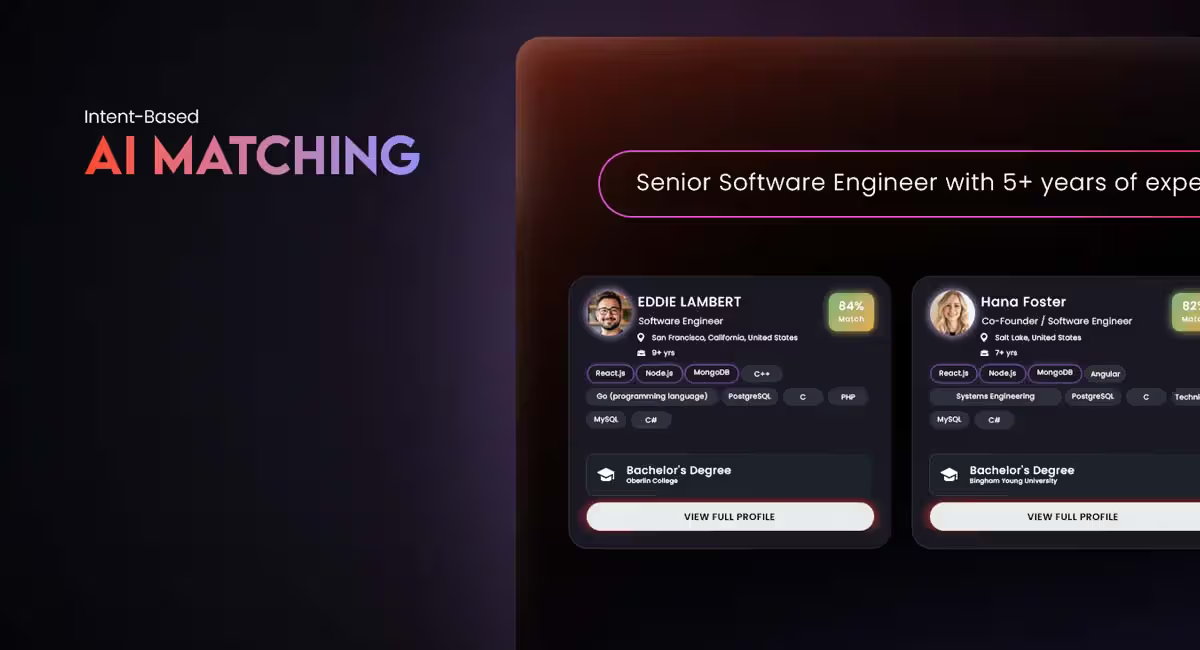
Inside ConnectDevs, intent-based matching is driven by Scout, the AI talent sourcing Agent. Scout uses a multi-layer ranking system that evaluates candidates far beyond keyword appearance.
Here's how the process works at a high level:
1. Contextual Job Parsing
Scout ingests the job description, cleans it, and uses contextual language modeling to understand the role: what success looks like, what the core responsibilities are, and which skills actually matter.
2. Skill-to-Role Relevance Scoring
Instead of checking whether a skill string appears on a resume, Scout analyzes how a candidate's experience, projects, and past roles align with the intent of the job. This supports more precise AI candidate ranking and helps distinguish surface mentions from actual practice.
3. Learning From Similar Roles and Outcomes
Over time, the system can incorporate patterns from previous searches and successful placements (where teams provide feedback), helping refine which profiles tend to perform well in similar contexts. This doesn't replace human judgment, but it gives recruiters a stronger starting point.
4. Structured, Evidence-Based Ranking
Rather than claiming "bias-free" decisions, ConnectDevs focuses on structured, evidence-based rankings. Scout uses contextual signals and consistent criteria to score candidates, giving hiring teams a transparent basis for comparison while keeping humans in control of final decisions.
5. Continuous Match Refinement
As teams search, shortlist, and hire, the system can improve its understanding of what "good" looks like for different roles and markets. Similar to how experienced recruiters become more accurate over time, the matching logic becomes more aligned with real-world outcomes.
6. Smart Suggestions and Adjacent Talent
Beyond direct matches, Scout surfaces adjacent candidates, people who may not match every requirement today but show strong alignment on core skills and trajectory. This helps teams build deeper, future-ready pipelines instead of one-off lists.
This type of matching allows ConnectDevs to produce high-signal shortlists in minutes, not hours, while giving recruiters clear context behind each recommendation.
Key Benefits of Intent-Based Matching
Deeper Accuracy
Intent-based matching evaluates whether a candidate can perform the responsibilities listed, not just whether their resume contains similar words. It looks at experience patterns, project types, and demonstrated outcomes.
Better Seniority Alignment
Scout can factor in leadership indicators, scope of ownership, and project complexity, dimensions that keyword systems struggle to recognize. This helps differentiate a mid-level contributor from someone who has owned strategy or led teams.
Stronger Experience Matching
Instead of checking that "Kubernetes" appears on a resume, intent-based matching looks at how and where the candidate used it: for example, maintaining a cluster, designing deployments, or leading a migration.
Reduced Noise
Because the engine focuses on role intent and relevance, hiring teams spend less time reviewing obviously off-target matches created by simplistic keyword filters.
More Consistent, Structured Evaluation
By using the same intent model and scoring logic for every search, teams get more consistent rankings and a clearer understanding of why certain candidates are surfaced. This helps support more equitable, transparent evaluations than ad-hoc keyword searches alone.
Use Cases Where Intent-Based Matching Wins
1. Startups With No Internal Recruiter
Founders can generate ready-to-review shortlists quickly, without learning complex Boolean strings or sifting manually through hundreds of profiles. Scout handles the heavy lifting, while founders focus on final selection and conversations.
2. Hiring Teams Screening Multiple Roles
When multiple roles are open across engineering, product, and go-to-market, intent-based matching helps manage cross-role complexity and rank candidates according to the specific requirements of each position.
3. Agencies Managing Talent Across Multiple Clients
Staffing and recruiting agencies can use ConnectDevs to surface better-aligned candidates for each client brief and turn around shortlists faster, without relying solely on manual search and internal spreadsheets.
4. Teams Hiring in Competitive Markets
When timing matters, reaching the right candidates first is critical. Intent-based matching helps identify high-potential profiles earlier, so teams can start outreach before their competitors.
5. Large Applicant Pools
For roles that attract hundreds of applicants, intent-based matching filters out noise and highlights candidates whose experience and trajectory align with the role, not just those who optimized their resume for keywords.
How ConnectDevs Outperforms Traditional Search Systems
ConnectDevs is built to understand the complexity of modern roles. Powered by AI Talent Sourcing Agent – Scout, the platform uses an 800M+ profile graph and layers:
- Experience patterns across roles and industries
- Seniority indicators and scope of ownership
- Skill dependencies and adjacent competencies
- Industry- and domain-specific role expectations
- Work history and collaboration signals that matter to hiring teams
Crucially, ConnectDevs doesn't stop at search. The platform brings together:
- AI talent sourcing (Scout)
- Intent-based AI matching and candidate ranking
- AI interviews and structured evaluation (SAM, the Expert Interview Agent)
This creates a connected hiring intelligence stack instead of isolated tools. In recent times, AI Interviewers Are Reshaping Modern Hiring. Recruiters and founders get a single environment where they can go from "define the role" to "review a curated shortlist with interview signal" without rebuilding context at every step.
The Future of Candidate Search
In the coming years, contextual matching is likely to evolve further toward more predictive decision-support. Industry-wide, we can expect models that provide richer indicators such as:
- Likely success in specific types of environments
- Trajectory signals based on past roles and growth
- Adaptability across adjacent roles or domains
These should be treated as inputs, not verdicts, tools that help recruiters ask better questions and prioritize their time, not automated decision-makers.
Teams adopting intent-based matching today are already ahead of the curve. They're replacing keyword-driven noise with context-aware, explainable results that better reflect the real demands of modern roles.
Conclusion
Keyword-based recruiting struggles in a world where roles evolve quickly, and applicant volumes continue to rise. Intent-based matching, AI talent sourcing, and structured AI candidate ranking offer faster, cleaner, and more accurate shortlists by focusing on role intent and real experience instead of resume formatting.
Scout, the AI talent sourcing Agent inside ConnectDevs, is built to understand job context, evaluate skill relevance, and refine accuracy with every new search, while keeping recruiters and hiring managers fully in control of final decisions.
If your team is ready to move beyond keyword noise and adopt an intelligence-first approach to sourcing, intent-based AI matching is a practical, scalable step forward.
Recent blogs
View allTalent Intelligence Platform: What It Is and How to Choose One in 2026
Oct 07, 2026
How to Reduce Candidate Ghosting: 9 Tactics Recruiting Teams Use in 2026
Oct 07, 2026
AI Candidate Screening Software: How to Evaluate the Best Tools in 2026
Oct 06, 2026

LinkedIn Recruiter Alternatives in 2026: 9 Tools Compared
Oct 01, 2026
Candidate Enrichment: What It Is and How It Fixes Incomplete Candidate Data
Sep 30, 2026