
Dec 15, 2025 · 8 min read
How AI Interviewers Are Reshaping Modern Hiring: Speed, Consistency, and Better Signal

Saad Sufyan
Share:
Founder & CEO @ Codesy Consulting | Building ConnectDevs, an AI-Powered Hiring Platform | Helping Companies Scale with Elite Software Engineers, AI Solutions & Digital Transformation | Worked with Startups, Enterprises & Fortune 500 Brands
Hiring teams everywhere are under pressure to move faster, hire smarter, and reduce reliance on manual interviews that often take days to schedule and weeks to complete. Traditional screening methods depend heavily on human availability, subjective impressions, and inconsistent criteria. As recruitment volumes rise and remote hiring becomes standard, teams are turning to AI interviewer technology to streamline the earliest and most time-consuming parts of the hiring cycle.
ConnectDevs operates as a full-cycle hiring intelligence platform, not just an interview bot. Within our triad of agents, SAM, the Expert Interview Agent, runs structured, domain-aware interviews and gives recruiters a clear view of strengths, risks, and overall fit so they can move with confidence.
In this blog, we'll explore how automated interviews, AI hiring tools, and AI screening are transforming modern recruitment. We'll also walk through the capabilities of SAM, the ConnectDevs AI interviewer, and explain why voice/chat-based evaluations and structured reports are becoming a core layer for future-ready hiring teams.
Why Traditional Interviews Slow Down Hiring
Most hiring teams know the pain points associated with early-stage interviews. Recruiters spend hours scheduling candidates, following up, taking notes, and trying to evaluate soft skills on tight timelines. These delays often extend the hiring process by weeks, especially when multiple roles and stakeholders are involved.
Traditional interviews create problems such as:
- Scheduling inefficiencies that stretch timelines
- Inconsistent scoring across different interviewers
- Subjective bias and mood-driven impressions
- Limited visibility into how candidates think under pressure
- Slow feedback loops between recruiters, hiring managers, and clients
These limitations become even more visible at scale. Agencies, RPOs, and high-growth startups reviewing hundreds of applicants need a faster way to assess communication, reasoning, clarity, and basic role fit, without waiting for manual availability. This is where AI interviewer systems step in as a decision-support layer.
What Is an AI Interviewer and How Does It Actually Work?
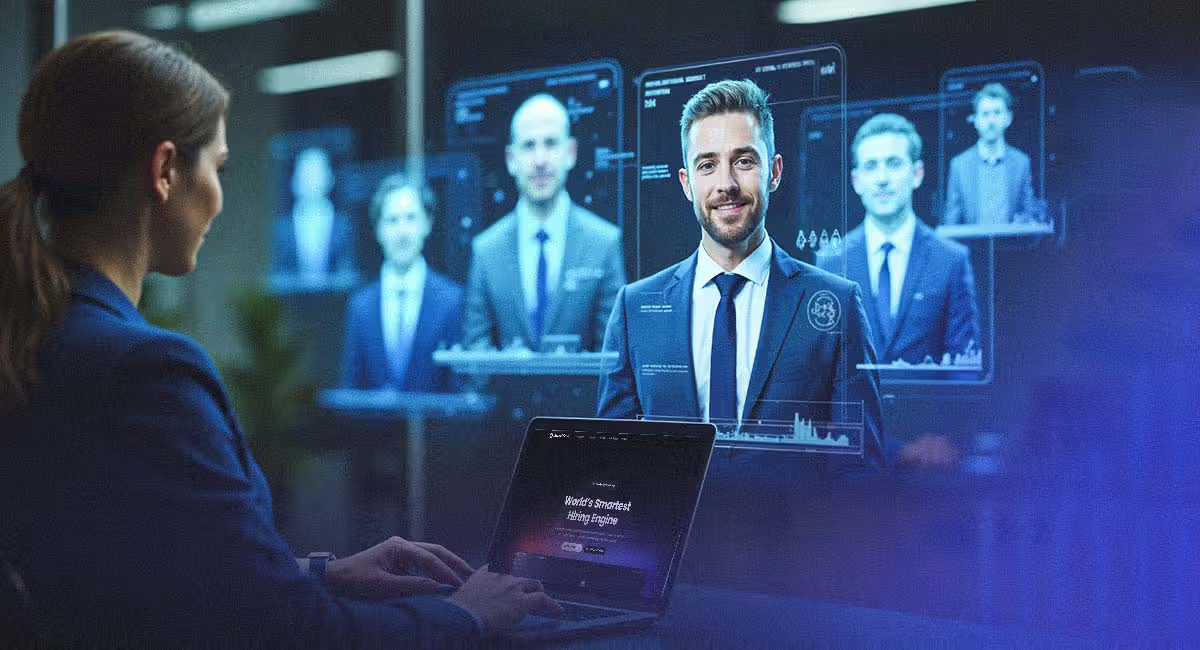
An AI interviewer is a system that conducts structured interviews without requiring a human to be present on every call. Instead of waiting for a screening round, candidates receive a secure link, join an interview session on their own time, and respond to questions generated by domain-aware models.
In ConnectDevs, the AI Interview Agent, Sam, is that layer. It runs role-specific interviews, scores core competencies, and produces a structured Interview Report that recruiters can review in minutes.
Modern AI hiring tools typically combine several capabilities:
1. Voice- and Chat-Based Interview Delivery
Candidates interact through asynchronous chat and, where enabled, voice. The system asks structured questions that can be tailored to role, seniority, and function. This creates a more natural experience than static forms while still staying highly consistent across candidates.
2. Real-Time Language and Communication Analysis
As candidates respond, the AI evaluates clarity, structure, reasoning, and other communication signals that rarely show up in resumes or portfolios. This gives a richer, more comparable view of how someone explains their work and thinks through problems.
3. Behavioral and Technical Evaluation
For many roles, it's not enough to check keywords. An AI interviewer can be configured to cover both behavioral and technical dimensions: how someone collaborates, how they approach problem-solving, and how deep their domain understanding goes.
4. Structured Follow-Up Prompts
Instead of stopping at one surface-level answer, the interview can include follow-up prompts that ask candidates to go deeper or share concrete examples. This helps surface how they respond when challenged or asked to clarify their reasoning.
5. Instant Interview Summaries and Reports
Once the session ends, the system compiles a transcript, highlights key signals, and assigns competency scores. Recruiters can scan summaries in minutes instead of spending hours on raw notes.
This level of automation allows teams to scale interviews without scaling headcount, while keeping humans firmly in control of final decisions.
The Advantages of AI Interviewers Over Human-Only Interviews
The shift to AI interview technology is driven by four major benefits:
1. Consistent and Standardized Evaluation
Human interviews often vary based on mood, time pressure, or interviewer style. An AI interviewer applies the same structure, criteria, and scoring logic for every candidate, which makes comparisons fairer and easier to explain.
2. More Evidence-Led, Less Gut-Led Decisions
Instead of relying on memory and loose impressions, hiring teams get structured scores and written rationale for each competency. This doesn't remove bias entirely, but it does reduce noise and anchors decisions in observable responses rather than vague "vibes."
3. Faster Time to First Screen
Candidates don't need to wait for a recruiter's calendar slot. They can complete interviews on their own time, often within hours of receiving the link. For agencies and startups competing in fast-moving markets, this speed is a real advantage.
4. Deeper Insight Into Communication and Clarity
Resumes can't reveal tone, fluency, or reasoning style. Voice- and chat-based interviews help teams see how candidates explain trade-offs, collaborate with non-technical stakeholders, or handle ambiguity, all before a human interviewer steps in.
Together, these benefits compress screening time, improve signal quality, and give hiring teams more confidence in who advances to the next round.
How the ConnectDevs AI Interviewer (SAM) Works
Within the ConnectDevs triad, SAM is the Expert Interview Agent and decision-support engine. It's designed to act like a domain-aware interviewer that understands the role context and surfaces a clear signal for recruiters.
Here's how SAM enhances the interview experience:
1. Role- and Context-Aware Interview Design
SAM uses the role setup and enriched candidate profile to generate a role-specific interview. It can cover both technical and behavioral areas, depending on the job, from engineering and product to sales, support, and operations.
2. Asynchronous Chat and Optional Voice
Interviews are conducted asynchronously via chat and, where implemented, voice. Candidates can answer on their own time, without needing to coordinate with a recruiter's schedule.
3. Competency Scoring and Narrative Feedback
As candidates respond, SAM scores key competencies such as problem solving, analytical thinking, communication, responsiveness, teamwork, time management, and adaptability. Each competency includes both a numeric score and a qualitative explanation to give context behind the rating.
4. Structured Interview Report
Recruiters receive an Interview Report that typically includes:
- Candidate header (role, location, experience band)
- Overall fit indicator
- Radar-style view of scored competencies
- Strengths and areas to watch
- Detailed evaluation cards for each competency
- Full interview transcript, plus audio where applicable
Instead of starting from scratch, recruiters open a structured report and immediately see where a candidate stands and what follow-up questions they may want to ask in a human-led round.
5. Human-in-the-Loop Decisions
SAM does not make hiring decisions. It surfaces structured signal, scores, strengths, risks, and notes that recruiters combine with match scores, client context, and their own judgment to decide who to advance, keep warm, or decline.
Use Cases: Where AI Interviews Create the Most Impact
High-Volume Roles
Customer support, SDRs, junior engineers, and operational roles often attract hundreds of applicants. Automated interviews help teams quickly filter for communication, basic competency, and intent before bringing in human interviewers.
Agencies and Recruiters Running Multiple Searches
Recruitment agencies and in-house talent teams running many parallel roles can use SAM to standardize first-round screening, so consultants spend more time on relationship-building and closing offers, not repetitive phone screens.
Founders Hiring Without a Full TA Team
Startup founders often manage hiring on top of product and fundraising. AI interviews reduce hours of manual prep, scheduling, and note-taking so founders can review clean reports and focus only on candidates who pass a consistent bar.
Hard-to-Assess Roles
Roles in product, strategy, and creative fields rely heavily on clarity of thought and communication style. AI interviews help surface how candidates structure ideas, explain past work, and navigate trade-offs, beyond what a portfolio alone can show.
Why AI Interviews Improve Quality of Hire
The difference between manual and AI-assisted interviews is not only speed, but it's also signal quality.
AI interviews improve decision quality by:
- Scoring core competencies against the same rubric for every candidate
- Highlighting strengths, risks, and areas to probe in later rounds
- Providing a written, auditable explanation for scores and recommendations
- Making it easier to compare candidates side by side on like-for-like criteria
- Reducing dependency on memory and scattered notes from multiple interviewers
The result: teams get a clearer, more structured view of each candidate before investing time in live interviews.
The Future of Screening: Deeper AI Evaluation Layers (With Humans in the Loop)
As AI hiring workflows mature, we can expect interview layers to become even more specialized and tightly integrated with sourcing and outreach. Trends likely to shape the next few years include:
- Role-specific interview templates for different functions and seniority bands
- Multi-language interviewing to support global candidate pools
- Richer decision-support indicators that combine interview performance with other signals
- Tighter integration between sourcing, shortlists, outreach campaigns, and interviews
ConnectDevs is deliberately moving in this direction as a hiring intelligence platform: Scout handles intent understanding, sourcing, and enrichment; Pilot turns Shortlists into campaigns and invites; SAM runs domain-aware interviews and returns structured reports. Together, they give teams a single pipeline from "search" to "interview-ready" candidate, with humans making the final call.
Conclusion
The recruitment landscape is changing quickly. Rising candidate volumes, distributed teams, and higher expectations around fairness and clarity mean traditional, fully manual interview processes are no longer enough on their own.
AI interviewer technology, when treated as a structured decision-support layer rather than a replacement for recruiters, helps teams move faster, evaluate more consistently, and see deeper into how candidates think and communicate.
With SAM, the Expert Interview Agent inside ConnectDevs, hiring teams get instant interviews, structured competency scoring, and clear Interview Reports that support better decisions with less manual effort. For agencies, startups, and in-house teams alike, AI-based interviewing is becoming a core part of a modern, intelligence-led hiring stack.
Recent blogs
View allTalent Intelligence Platform: What It Is and How to Choose One in 2026
Oct 07, 2026
How to Reduce Candidate Ghosting: 9 Tactics Recruiting Teams Use in 2026
Oct 07, 2026
AI Candidate Screening Software: How to Evaluate the Best Tools in 2026
Oct 06, 2026

LinkedIn Recruiter Alternatives in 2026: 9 Tools Compared
Oct 01, 2026
Candidate Enrichment: What It Is and How It Fixes Incomplete Candidate Data
Sep 30, 2026